
Who Needs AML Registration in the UAE? A Sector-Wise Breakdown

When most business owners hear the term AML registration, they assume it applies only to banks and financial institutions. That is no longer true.
In the UAE, Anti-Money Laundering compliance now extends far beyond the financial sector. Many non-financial businesses are legally required to register, implement compliance frameworks, and report suspicious activity. Yet a surprising number of companies still do not realise they fall under these rules.
The result is simple. They discover their obligations only when regulators contact them.
By then, the damage is already done.
If you operate in the UAE, understanding whether AML registration applies to your business is not optional. It is a core part of your tax and compliance responsibilities.
Let us break it down clearly.
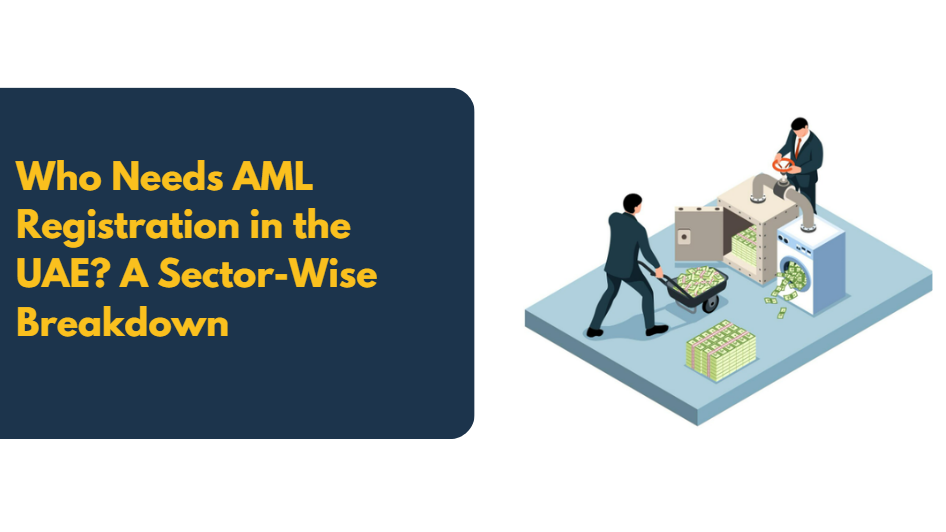
Why AML registration matters
The UAE has strengthened its AML and Counter-Terrorist Financing laws to align with global standards. Authorities expect businesses to monitor transactions, assess risks, and maintain proper records.
This is not a box-ticking exercise. Registered entities must show that they have policies, due diligence procedures, staff training, and reporting systems in place. Regulators want proof that compliance is embedded in daily operations.
Failure to register or comply can lead to fines, inspections, restrictions, and reputational concerns. For many businesses, this risk is far more expensive than the cost of building proper systems.
In simple terms, AML compliance protects both your business and the financial ecosystem you operate in.
Who must register for AML in the UAE?
AML registration typically applies to businesses classified as Designated Non-Financial Businesses and Professions. These sectors handle transactions that could be misused for money laundering or illegal fund flows.
Here is a sector-wise breakdown -
Accounting and audit firms
If your firm provides accounting, bookkeeping, or audit services, you are required to comply with AML regulations.
These firms handle financial records and transaction reviews. That gives them visibility into client funds. Regulators expect such businesses to identify suspicious activity and report it when required.
In addition to business tax compliance and corporate tax compliance work, accounting firms must maintain AML policies and risk assessments.
Corporate service providers
Businesses that assist with company formation, nominee services, or business structuring fall under AML obligations.
These providers often handle ownership structures and cross-border transactions. This creates higher exposure to financial risk.
If you help clients set up or manage companies in the UAE, AML registration is usually mandatory.
Real estate brokers and agents
Real estate involves large-value transactions. This makes the sector sensitive from a regulatory perspective.
Brokers must conduct customer due diligence, verify sources of funds, and maintain proper documentation. Registration with the goAML system is part of the requirement.
If you facilitate property sales or leasing, AML compliance is not optional.
Dealers in precious metals and stones
Gold, diamonds, and similar commodities are frequently monitored because they can be used to move value quickly.
Dealers, traders, and businesses operating in DMCC or similar zones must comply with AML rules. Proper transaction monitoring and reporting systems are essential.
Other regulated professionals
In some cases, consultants or advisory firms that handle client funds or high-risk transactions may also fall under the AML scope. It depends on the nature of the services offered.
If your business deals with large payments or complex ownership structures, it is worth assessing your exposure.
What AML compliance actually involves
Registration is only the first step.
Once registered, businesses must build a working compliance framework. This usually includes:
AML policies and procedures
Business and customer risk assessments
Customer Due Diligence and KYC checks
Enhanced Due Diligence for higher risk cases
goAML reporting processes
Staff training
Regular compliance reviews
These systems must be documented and easy to demonstrate during inspections.
This is where many SMEs struggle. They register but fail to implement proper controls. Regulators look beyond paperwork. They want evidence that processes are followed consistently.
Where tax and AML overlap
Many businesses treat AML and tax compliance separately. In reality, they are closely connected.
Weak records create risk on both fronts.
If your documentation is poor, it affects tax compliance, business tax compliance, and AML reporting at the same time. Inconsistent books make it harder to justify transactions. That increases scrutiny during audits and inspections.
Strong financial systems support both corporate tax compliance and AML requirements. Clean records reduce questions. Clear trails build trust.
This is why an integrated tax and compliance approach works better than managing each area in isolation.
How Lumos Advisory supports your compliance
At Lumos Advisory, we help businesses understand whether AML registration applies and how to implement practical frameworks.
Our services include:
AML policy and procedure drafting
Risk assessments
Customer Due Diligence frameworks
goAML registration and reporting support
Compliance health checks
Staff training
Inspection preparedness
Alongside this, we provide tax compliance services in Dubai, including VAT and Corporate Tax filings, transaction reviews, and structured documentation support.
By combining AML and tax compliance under one advisory approach, we help businesses stay prepared rather than reactive.
Final thoughts
If you operate in accounting, real estate, corporate services, or precious metals, AML registration likely applies to you.
Ignoring it is not worth the risk.
Compliance today is about preparation, not correction. Clear records, strong processes, and consistent oversight protect your business and your reputation.
If you are unsure about your obligations, getting clarity early is always easier than responding to regulators later.
Lumos Advisory helps businesses manage both AML and tax compliance with structure and confidence, so you can focus on growth while staying fully aligned with UAE regulations.

Comments